

- The United States is grappling with inflation and a war with Iran that may be nearing its end. For the U.S. president, inflation above 4% is a problem ahead of the elections, as internal political factions begin to grow restless.
- The ECB raised rates by 25 basis points, as expected, to counter inflationary pressure driven by higher energy costs. The euro remains stable.
- EUR/USD has been stuck for some time in a narrow range between 1.15 and 1.16. Alternating winds of war and possible peace continue to feed the current stalemate.
Inflation Surges in the United States
The ECB did what it had to do, raising rates by 25 basis points and then moving into wait-and-see mode as it awaits its own inflation data. The mood is mixed: on one hand, confidence that a truce agreement between Iran and the U.S. could reopen Hormuz and cool oil prices; on the other, concern that renewed fighting could push that scenario further out of reach and fan the flames of inflation.
Real policy rates remain negative, which partly explains the euro’s inability to break through resistance levels. But inflation is also beginning to unsettle Trump in the U.S.
U.S. inflation data were released, and as expected, consumer prices rose 4.2%, up from 3.8% in April. Core inflation also climbed, reaching 2.9%.
Equity markets did not take the report well, though investors are still looking with some confidence at the decline in oil prices and the prospect of a definitive truce on the horizon. Markets, however, have another concern: a Federal Reserve that may be less independent than in the past.
The next few months will be crucial in determining what Kevin Warsh is made of. But the inflation issue Trump once used as an electoral weapon against Biden now risks turning against the tycoon himself in the midterm elections.
The Fed’s rate-cutting policy had undoubtedly cooled mortgage rates, but they have started rising again in step with the cost of 10-year debt in the market. That reflects growth, yes, but also a reduced appetite among foreign investors for buying U.S. dollar debt at yields that, in the face of a Fed standing still, risk becoming increasingly unattractive and negative in real terms. That, in turn, is putting pressure on the greenback.
EUR/USD: Nothing New in Sight for Now
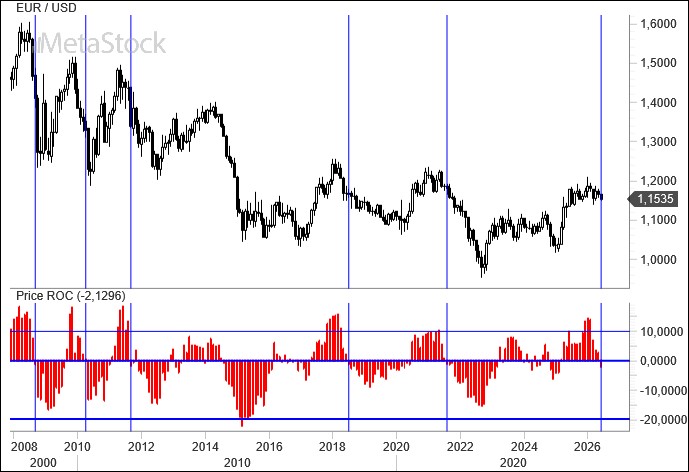
The event is worth noting. When EUR/USD gains more than 10% over 12 months and then slips back into negative territory on a yearly basis, as it has now, the path for the following months appears to be set: a further decline in the exchange rate.
At the moment, one can hardly speak of a true downtrend, given the exhausting sideways movement between 1.14 and 1.19. But when volatility is compressed for too long, it eventually tends to explode all at once, in one direction or the other.
As far as EUR/USD history is concerned, this pattern of bearish evolution appears to be confirmed on the charts. With the exception of the dramatic declines of 2008 and 2010, which in any case continued for another month with long black candles, subsequent episodes in which the pair moved from positive to negative territory on a year-over-year basis have always been followed by declines in EUR/USD.
We will see whether this time is different. But a bearish break below 1.14 should be interpreted as strongly bullish for the dollar.
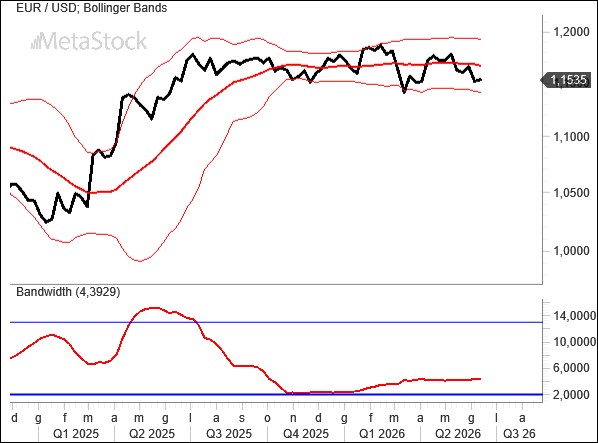
It does not take much analysis to understand that volatility is the great absentee in the EUR/USD market. For nearly a year now, after the post-Liberation Day surge, EUR/USD has been moving between 1.14 and 1.19, with still-limited swings. As confirmed by the Bollinger Bands, which are very close together, the pair offers little opportunity even for long-short speculation, given the slow pace of movement between support and resistance levels.
Leave a Reply
You must be logged in to post a comment.