
- The Federal Reserve struck a cautious tone on inflation and did not rule out a rate increase by year-end. The dollar benefited, though Warsh will have to navigate a sharply divided FOMC.
- After raising rates, the ECB will closely monitor the inflationary dynamics triggered by the destabilizing effects of the war in the Gulf. Another rate increase is still expected by the end of the summer.
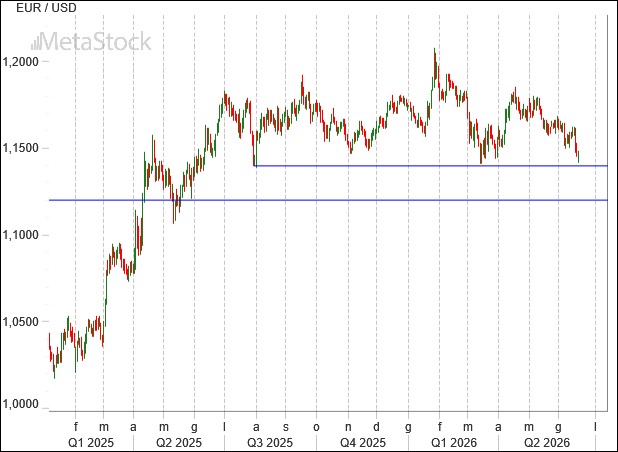
- EUR/USD moved decisively lower after the FOMC meeting, making clear what traders expect from the Fed. Watch 1.14, the key support level for the coming weeks.
A Divided FOMC
The first meeting of the Warsh era ended with no action. Rates were left unchanged at 3.5%–3.75%, but the dovish bias was removed. Nine of the 18 members formally leaned toward an increase in the Fed Funds rate. The chairman refrained from giving explicit guidance in that direction, but it is clear that two distinct camps have formed inside the Fed. The labor market remains reassuring, but the focus necessarily shifts to inflation.
The dollar reacted immediately, strengthening and pushing EUR/USD below 1.15, while markets have even begun pricing in the possibility of a summer rate increase.
Should the geopolitical variable be resolved by a U.S.-Iran agreement and oil prices ease, the economic recovery – which never really left the United States – could regain momentum. Inflation, in turn, could remain a live issue given the recent trend in producer prices. The GDP deflator is expected to stand around 3.5% at year-end, a level the Fed cannot ignore, even with elections approaching. The first signal, after all, came from May retail sales, which rose sharply.
In Europe, investors are looking with confidence to the reopening of Hormuz and the resulting easing in gas and oil prices, both of which are needed to weaken inflation and prevent the ECB from going further with interest-rate increases. That is another reason why the euro lost ground in the post-Fed session.
EUR/USD: What If the Future Is Bearish?
The chart that may best sum up the current state of the U.S. dollar is perhaps the monthly Dollar Index chart.
A bullish sequence began after the 2008 crisis and coincided with a period of remarkable relative strength for U.S. equities.
After a tentative start, the Dollar Index staged a powerful rally from 2012 onward, reaching its 2016 high, from which a correction began and lasted until 2021.
The post-Covid peak in 2022 gave way to a corrective phase that, in recent months, has repeatedly tested the uptrend line. Each time, support held and prevented a trend reversal. This phase tested the 96 area several times. That level is key not only because it represents the 38.2% retracement of the bull market, but also because it is the price zone where the two corrective legs are equal. A move back above 102 in the Dollar Index would confirm that the correction has ended and that a bullish phase is ahead. We are not far from that level, which, translated into EUR/USD terms, can be identified around 1.14.

The post-Warsh reaction made clear that, for now, dollar weakness against the euro is not the main theme. A potential rate increase in the U.S. could well give the greenback fresh momentum. The importance of 1.14 first, and then 1.12, is therefore evident for the EUR/USD outlook.
The confirmation of a head-and-shoulders pattern, with a break below 1.14, would be a very strong clue about the pair’s next direction. At that point, EUR/USD could, somewhat unexpectedly, end the summer with a zero after the decimal point.
Leave a Reply
You must be logged in to post a comment.