
- There is still no breakthrough on the Iran war front, although an agreement appears to be within reach. Meanwhile, inflation is biting again in the U.S., nearing 4% in April. Pressure on newly appointed Fed Governor Warsh over rates is starting to build.
- Europe is heading into an ECB meeting that appears likely to bring a 25-basis-point rate increase, as policymakers try to contain rising inflation driven by persistent tensions in the Gulf.
- EUR/USD remains stuck around last week’s levels, trapped in a tiring and directionless trading range.
Peace, or No Peace?
The geopolitical backdrop remains deadlocked. There is still no agreement between Iran and the U.S., despite minor skirmishes and peace plans that appear to be nearing the finish line. Russia and Ukraine, meanwhile, continue to fight along the front line, with Kyiv asking Trump for military assistance and the European Union for political backing.
The market, however, appears to have already reached a few conclusions, including on expected inflation in the U.S. Real yields on short-dated TIPS, with maturities of less than two years, are close to 3%, while the 10-year rate has eased to 2.5%. That suggests investors see the current inflation spike, driven mainly by energy prices, as temporary.
The Dollar Index has shown a lively tone in recent weeks, and one that has become detached from the market volatility that typically accompanies periods of dollar strength. Since the outbreak of the war, increases in the VIX index had coincided with a stronger greenback, and vice versa. More recently, however, record highs in equity markets and a VIX stuck in calm mode have still coincided with a rebound in the Dollar Index, although the yen has played a major role in that move. It remains a divergence that may point to the need for a realignment, either through a rise in volatility or a renewed weakening of the dollar.
In the U.S., the PCE index, the inflation gauge long used by the central bank as its reference point, rose 3.8% in April, up from 3.5% in March. That figure increases pressure from the hawks on newly appointed Governor Warsh to keep monetary policy restrictive.
The minutes from the latest ECB meeting, meanwhile, suggest Frankfurt is prepared to act restrictively on rates at its next meeting on June 11, when the cost of money is expected to be raised to 2.25%. The impression is that the central bank wants to strengthen its image as an independent institution. Will the same still be true for the Fed?
The Dollar Likes War
Time is passing, but the dollar has still failed to seize the advantage that the monthly stochastic oscillator seemed ready to offer as far back as late 2025, when a bearish signal opened the door to a more favorable phase for the greenback. Instead, all of this has translated into sideways trading that has produced little or no advantage for the dollar.
As long as the oscillator remains in this position, a recovery by the euro looks difficult. Still, a few months from now, the single currency could return with the right conditions to make another attempt at breaking resistance. Once the oscillator has fully reset into oversold territory, history suggests that a major bottom, one with the potential to last for a long time, could then be in the making.

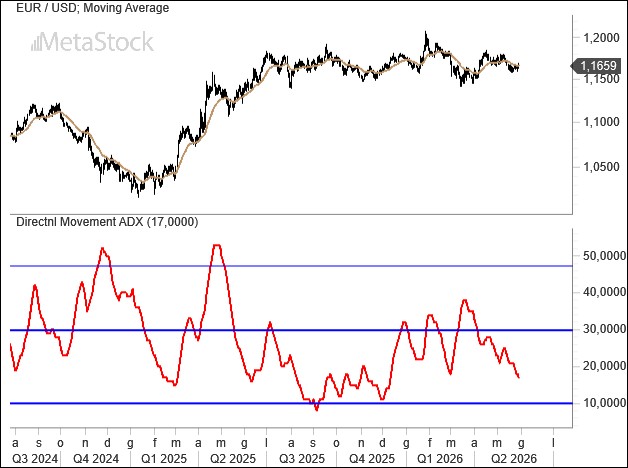
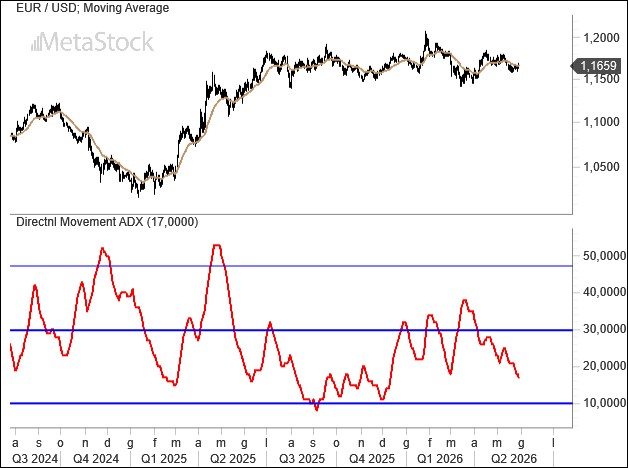
Volatility continues to contract on EUR/USD, with the ADX also slipping back below 30 points. This signals that the trend is essentially absent, with bulls and bears in complete balance.
The indications from last week therefore remain unchanged. Only above 1.19/1.20 would it be possible to start considering a stronger euro. Below 1.14, however, the scenario would become decidedly more bullish for the greenback.
Until then, everything remains on standby.
Leave a Reply
You must be logged in to post a comment.