
- Kevin Warsh, the Fed’s new governor, will need to rely on diplomacy to convince Trump that cutting rates now would be dangerous. The economy is running strong, inflation is still moving, and markets are now even pricing in the possibility of a hike. Equities remain close to record highs, while bonds continue to sell off.
- Europe is dealing with high energy costs and growing calls from several countries for budget deviations, adding pressure to long-dated bond yields. The ECB is preparing the ground for tighter policy.
- EUR/USD pulled back and closed the week between 1.15 and 1.16. The dollar’s favorable momentum has been driven by more hawkish expectations for U.S. interest rates.
Powell’s Final Meeting Strikes a Hawkish Tone
The minutes from the final FOMC meeting chaired by Jerome Powell highlighted a Fed that remains concerned about rising inflation and appears to rule out further interest-rate cuts. Fed Funds futures have lifted the probability of a 25-basis-point rate increase to 75%, even though Kevin Warsh will now be at the helm. Warsh will have to walk a tightrope between an economy still expanding at a solid pace, inflation that continues to bite, and a president who will likely push for rate cuts ahead of the midterm elections.
The June 16-17 FOMC meeting should offer more clarity. It is worth recalling that among Warsh’s first public comments were his intention to change the Fed’s reference inflation measure and his belief that artificial intelligence could boost productivity and act as a disinflationary force.
Meanwhile, in Europe, the countdown has begun toward a possible ECB rate increase, after April inflation rose to 3% from 2.6%, setting off an initial alarm bell in Frankfurt. Several governments, including Italy’s, are asking Brussels for greater fiscal flexibility to counter the impact of higher energy costs.
On the Iran war front, the ceasefire phase continues, with negotiations still under way. But the talks have not yet allowed oil prices to fall meaningfully, given the reciprocal naval blockades around the Strait of Hormuz. Each passing day appears to add fuel to inflationary pressures that, without adequate countermeasures on rates, risk becoming embedded across the entire production chain. The 6% jump in U.S. producer prices in April is a clear example. For now, EUR/USD remains stuck in a holding pattern.
EUR/USD: Still Nothing New to Report
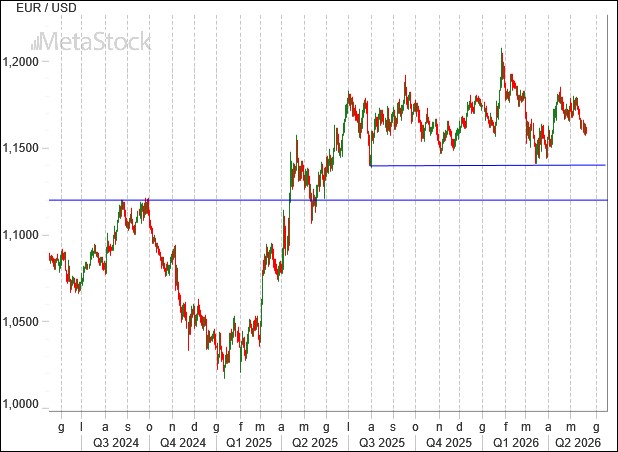
The EUR/USD chart clearly shows the trading range that continues to hold the pair in place. It also points to a potential bearish head-and-shoulders formation that, if confirmed by a break below the 1.14 neckline, could open the door to an unexpected euro bear market.
From a seasonal standpoint, it will be difficult for the dollar to force a break of support before the end of the summer. But if the euro fails by then to break above the 1.19-1.20 area, a year-end scenario favoring the dollar should not be ruled out.
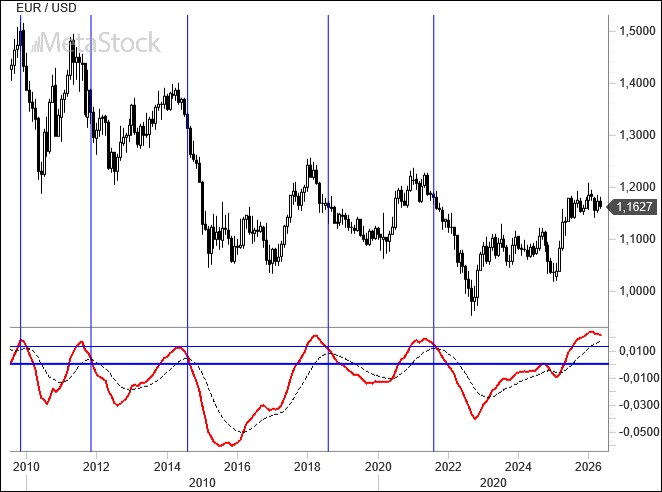
Another chart we are again including in this report, and which confirms the potential for a renewed phase of dollar strength against the euro, is the monthly EUR/USD chart combined with the MACD oscillator.
Since 2008, whenever the signal line has crossed the MACD from above to below, it has confirmed a positive phase for the U.S. currency, with the dollar continuing to strengthen for several more months. That signal has not arrived yet, but it appears close, with the MACD now at particularly high levels. This is worth watching, especially as the period from late summer onward tends to become seasonally more favorable for the dollar.

Leave a Reply
You must be logged in to post a comment.