
- The guns are quieting and diplomacy is trying to bridge the divide between Iran and the U.S. in an effort to reopen the Strait of Hormuz. Energy prices, however, remain high. Meanwhile, in the U.S., the Warsh era at the Federal Reserve begins, with the new chair now needing to prove his independence from Trump.
- The ECB has suggested that the next data releases will be decisive in formalizing another rate increase in June. Inflation needs to be stopped early to avoid a second wave like the one that followed the pandemic.
- EUR/USD remains in the upper part of its trading range, with the dollar’s weakness becoming evident every time markets shift back toward optimism.
Between Hopes for Peace and Inflation Fears
As talks between Iran and the United States move forward, markets are hoping for a reopening of trade routes through Hormuz. Equity markets remain close to record highs, while bonds are struggling to recover from the losses suffered in recent weeks. The rise in oil prices has already done damage, and that damage is likely to spread through the global economy in the coming months in the form of inflation.
Uncertainty still dominates, however, partly because skirmishes between the two sides continue and the strait has not yet fully reopened.
Some central banks have already raised rates, including Australia and Norway. Others are preparing to do so, such as Canada and New Zealand. Others still, including the ECB, may be ready to abandon what had seemed to be a stable level for the cost of money, in an effort to prevent inflation from running dangerously ahead.
In the United States, the question is how the new Fed chair will respond to such a challenging environment. Inflation is rising, employment is slowing, and stock markets are at record highs. Cutting rates, as Trump would like, risks fueling markets that could slip into a speculative mode that may be difficult to control later. After all, equities are already at record levels, and a rate cut at a time when long-term yields are rising could prove very risky.
Caution is therefore likely to prevail at the Fed for a while longer. But as the midterm elections draw closer, Trump will raise the pressure. That will be the moment when Warsh’s independence is truly put to the test.
EUR/USD: Little New for Now
The week just ended brought little news on the technical front for EUR/USD. Once again, positive headlines from diplomacy worked against the U.S. dollar, with the pair staying almost consistently above 1.17.
In the background, there is still a possible bearish head-and-shoulders pattern, with the neckline passing through 1.14. But for now, this remains only a technical hypothesis, and the market has shown little interest in confirming it. Investors prefer to focus instead on a Fed that looks more dovish than the ECB, on twin deficits that show no sign of narrowing despite Trump’s tariffs, and on concerns that the independence of the U.S. central bank may be at risk.

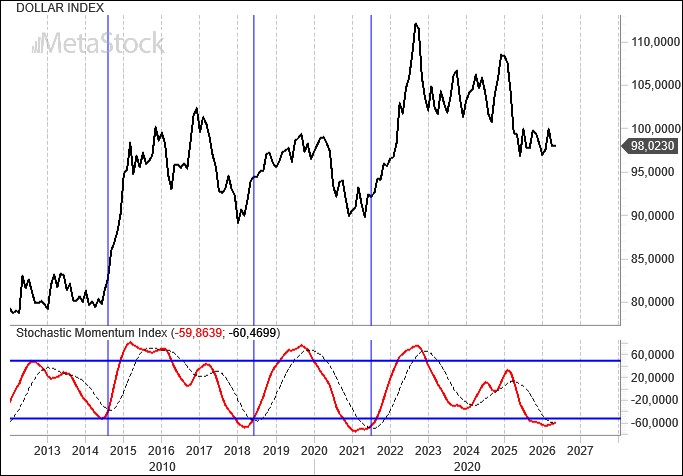
Confusion remains high in currency markets. Contradictory signals are emerging from EUR/USD and the Dollar Index across several time frames. At the moment, it is difficult to identify a clear strategy to rely on.
Looking, for example, at the Dollar Index on the monthly chart, the stochastic oscillator is far from being in a negative position.
On the contrary, the dollar may be ready for a bullish scenario, even if that conflicts with other shorter-term signals pointing in the opposite direction, including unfavorable seasonality for the greenback at least until the end of the summer.
With the recent trading range between 96 and 100, one could interpret the move as an accumulation phase ahead of a broader bullish move for the dollar in the coming months. We will see which forces ultimately prevail.
Leave a Reply
You must be logged in to post a comment.