
- The United States faces a Federal Reserve still reluctant to cut rates aggressively, given resilient growth and renewed wage pressures. But the real headline came from the Supreme Court, which struck down President Trump’s tariffs.
- In Europe, inflation continues to cool, while rumors of a possible early resignation by Christine Lagarde unsettled the euro during the week.
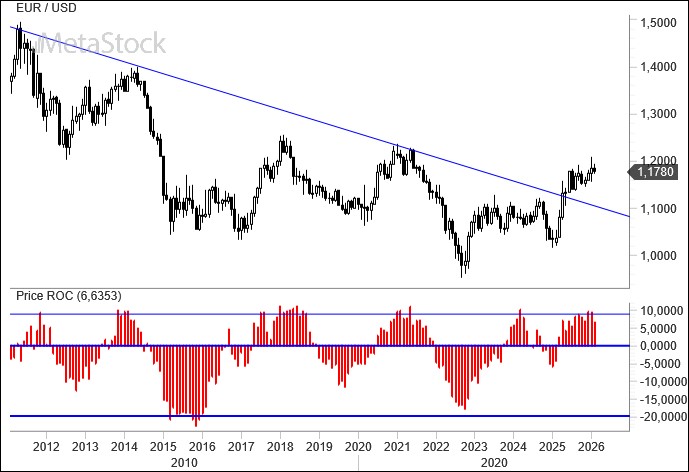
- EUR/USD remains locked in a stalemate between major resistance at 1.19 and distant support at 1.15.
Growth Holds in the U.S., but Tariff Uncertainty Clouds the Outlook
The release of minutes from the latest Federal Open Market Committee meeting confirmed that Jerome Powell and his colleagues continue to favor caution over aggressive rate cuts. Inflation is cooling, but economic growth and a still-resilient labor market have largely brushed aside recession fears that followed the sweeping round of Trump-era tariffs—now invalidated by the Supreme Court.
The ruling denies the President authority to impose broad trade tariffs. What remains unclear is the fate of duties already collected and the trade agreements negotiated in recent months. Meanwhile, President Trump has threatened an additional 10% global tariff, adding to policy uncertainty.
Wage pressures have resurfaced in the U.S., partly due to a tighter labor supply stemming from lower immigration flows. That dynamic may give the Fed reason to hold rates steady at least until June. Markets increasingly expect relatively hawkish monetary stances in other economies, including Australia, Norway and New Zealand.
Across the Atlantic, inflation continues to ease in the eurozone. France posted monthly declines in consumer prices, while speculation that Lagarde could step down before next year’s French elections has slightly weakened the euro.
U.S. equities, meanwhile, are trailing other global markets in both 2026 performance and over the past year. That underperformance is beginning—slowly—to chip away at America’s share of global market capitalization. The U.S. Dollar Index has signaled further softness, suggesting that the U.S. weighting could decline further in the months ahead.
Yet the long-standing correlation between dollar weakness and capital rotation away from U.S. assets has not fully materialized. The Dollar Index’s test of long-term support appears to be slowing the shift. Should those supports break—and EUR/USD push decisively above 1.20—the geographic rotation could accelerate meaningfully.
EUR/USD: Total Stalemate Despite the Supreme Court Shock
Technically, there is little to report on EUR/USD despite the tariff turmoil. The market remains deeply uncertain. The 18-month rate of change is consistent with the formation of a primary top, as has repeatedly occurred since 2010.
The two bullish legs of the current cycle converge in magnitude at 1.19, making that level a critical hurdle for defining the broader 2026 strategy.
The dollar continues to inspire limited confidence, now compounded by tariff uncertainty. Yet the euro has also failed to break above technical levels that would open the door to entirely new scenarios—possibly forcing the European Central Bank to act in order to temper excessive currency strength.
The result: absolute stalemate.
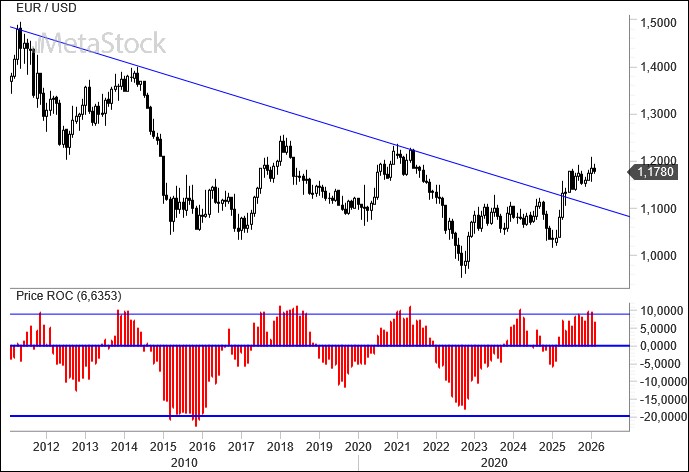
The pair remains compressed within a well-defined technical corridor. Resistance at 1.19 continues to cap advances, while support near 1.15 remains distant but structurally important. Momentum indicators reflect indecision rather than conviction.
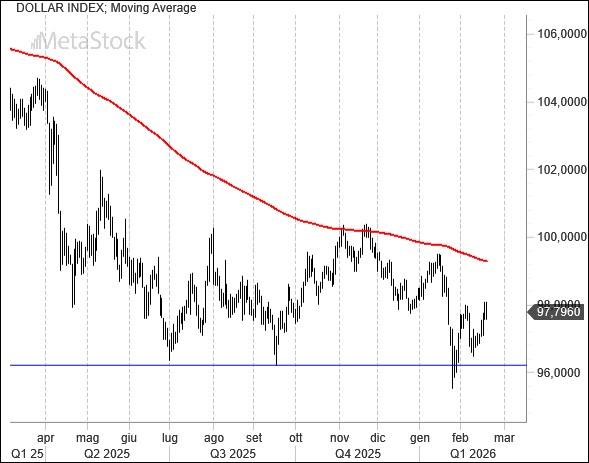
The Dollar Index appears to confirm last week’s emerging recovery, with prices attempting to retest resistance levels just below the 100 mark. What initially looked like a bearish breakdown now resembles a classic bear trap.
For now, the move is viewed as corrective. Whether it evolves into a broader reversal will depend on how the index behaves near resistance. A decisive break higher would shift the narrative toward renewed dollar strength.
Leave a Reply
You must be logged in to post a comment.