

- Donald Trump’s drive to secure new resources and trade routes appears to be extending across much of South America. After Venezuela, Colombia has become the latest country the tycoon seems intent on destabilizing politically. At the same time, rhetoric is escalating in Washington’s standoffs with China and Russia. The U.S. economy remains solid, but job creation is notably weak.
- Europe is watching tensions with the United States with growing concern, even as inflation retreats to 2%, right on the ECB’s target.
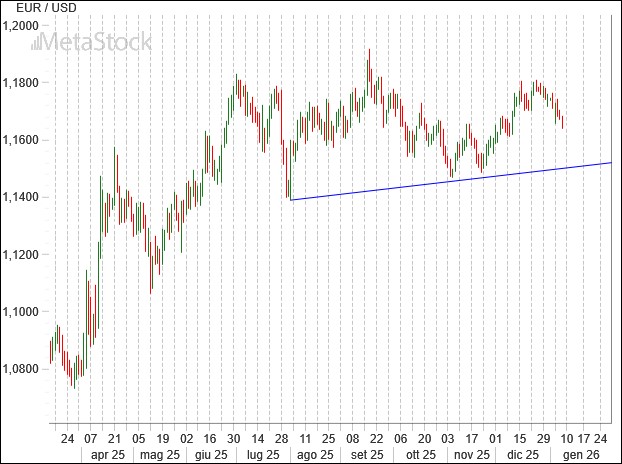
- EUR/USD is struggling to break through key resistance levels, in line with an unfavorable seasonal pattern. A continuation of the trading range looks likely, even as the pair slips back toward 1.16.
Geopolitical tensions intensify
The removal of Venezuelan President Nicolás Maduro has opened a new front in an already fragile geopolitical landscape. Russia and China were quick to condemn Washington’s move to replace the country’s leadership, an action widely seen as granting the U.S. de facto political and commercial influence over Venezuela—particularly when it comes to control of natural resources.
At the same time, Trump has raised the stakes for domestic reasons as well, seemingly attempting to deflect attention from the possibility of an unfavorable Supreme Court ruling on tariffs and from renewed scrutiny surrounding the Epstein case, which could potentially implicate him.
The president has broadened his rhetoric to include other Latin American countries such as Mexico and Colombia, while also reviving interest in Greenland—a Danish-controlled territory that the United States has previously floated the idea of “purchasing,” citing its wealth of raw materials and its strategic appeal amid growing Russian and Chinese interest. Tensions with Europe, already strained since the Ukraine conflict, remain unresolved.
U.S. data continue to offer reassurance, particularly in the non-manufacturing sector. The ISM services index came in well above expectations and improved from the previous month. Especially encouraging was the forward-looking new orders component, which reached its highest level in fourteen months. The prices-paid component also cooled, a welcome signal for the Federal Reserve, which can additionally point to a declining unemployment rate. Still, December job creation was modest, with fewer than 50,000 new positions added.
In the euro area, annual inflation has settled at 2%, perfectly aligned with official policy rates. Markets have so far placed their trust in Christine Lagarde, who has pledged continuity in monetary policy. The euro, however, has failed to benefit, retreating instead to around 1.16.
The single currency’s inability to push beyond resistance remains frustrating, though it is worth remembering that seasonality tends to favor the dollar through the end of February.
EUR/USD: resistance holds firm
The world’s most traded currency pair has so far been unable to overcome resistance at the start of the year. Excessive optimism toward the euro, combined with unfavorable seasonality, continues to support a range-bound market. The 1.15 area represents the first real test. This level coincides with the neckline of a potential head-and-shoulders pattern; a decisive break would likely drag EUR/USD down toward 1.125, with a possible extension to 1.105—the 38.2% retracement of the recent bull market.
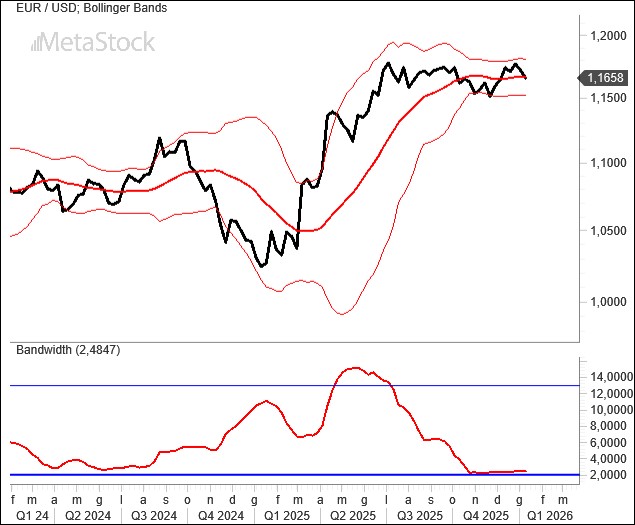
One factor that remains largely under the radar—but could have explosive consequences for EUR/USD—is volatility, which remains extremely compressed. Bollinger Bands once again highlight how close the upper and lower bands are, underscoring a tight trading range that could break in either direction and set a new trend for 2026. The levels to watch remain 1.19 on the upside and 1.15 on the downside—thresholds beyond which volatility in EUR/USD may finally have something to say.
Leave a Reply
You must be logged in to post a comment.