
U.S. employment is at a standstill due to the government shutdown, but Trump addresses the nation in an effort to restore confidence, announcing that the next Federal Reserve chair will soon be selected and that interest rates will be lowered to revive the economy.
In Europe, encouraging signals are coming from leading indicators, particularly in Germany, confirming a solid economic recovery that will allow the ECB to keep rates unchanged for an extended period.
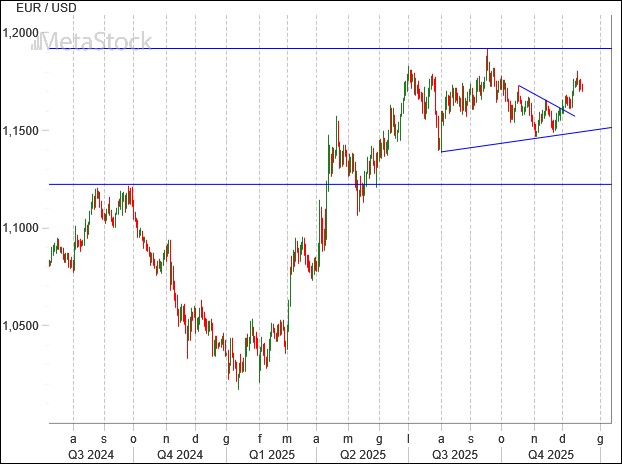
EUR/USD continues its gradual ascent toward resistance, stabilizing above 1.17. The prospect of a more aggressive monetary policy stance is weighing on the U.S. dollar.
U.S. Labor Market at a Standstill
Trump is presenting an America in strong recovery, placing the blame for inflation, immigration, and weakened diplomatic influence squarely on the previous administration. Beyond the political narrative, markets are increasingly concerned about the attempt to bring the Federal Reserve under indirect White House control through the appointment of Powell’s successor—someone who would be expected to take into account Trump’s preference for significantly lower interest rates than current levels.
With equity markets not far from record highs and inflation struggling to fall consistently below 3%, the risks associated with such a strategy are far from negligible. The dollar, in fact, is already paying the price for this backdrop.
The U.S. economy emerges weakened from the shutdown following the release of final labor market data for the September–November period. Average private-sector job creation over the quarter amounted to just 12,000 positions. October alone saw a loss of 105,000 jobs, before a partial recovery of 64,000 in November.
Labor cost growth stalled in November, bringing the annual growth rate down to 3.5%. The unemployment rate climbed to 4.6%, the highest level since September 2021. Only retail sales, which rose 0.8%, provided some relief in a data set that could ultimately force the Fed to implement more than one rate cut in 2026.
Inflation is easing, though the reading remains partial due to the lack of complete data from several districts.
In Europe, a number of interesting indicators—albeit slightly below expectations—have confirmed that the recovery is underway. Germany’s Ifo index held close to 90. PMI readings edged lower but remain above the 50 threshold. The ZEW index climbed to its highest level in five months. The ECB has confirmed that interest rates will remain unchanged throughout 2026.
Meanwhile, the Bank of England, following a clear cooling in inflation to 3.2% year over year versus expectations of 3.4%, and with unemployment rising to 5.1%, cut rates as expected to 3.75%.
EUR/USD Technical Analysis: A Crucial Year-End Turning Point
The bullish inverse head-and-shoulders pattern highlighted last week has taken shape, reaching what was its minimum target. The advance could find the 1.18–1.19 area to be an ideal zone of arrival before a renewed return of dollar buyers.
This phase would nonetheless serve as a prelude to another attempt by the greenback to pressure the euro in the 1.15–1.16 area, in an effort to break a trading range that has been evident for some time.
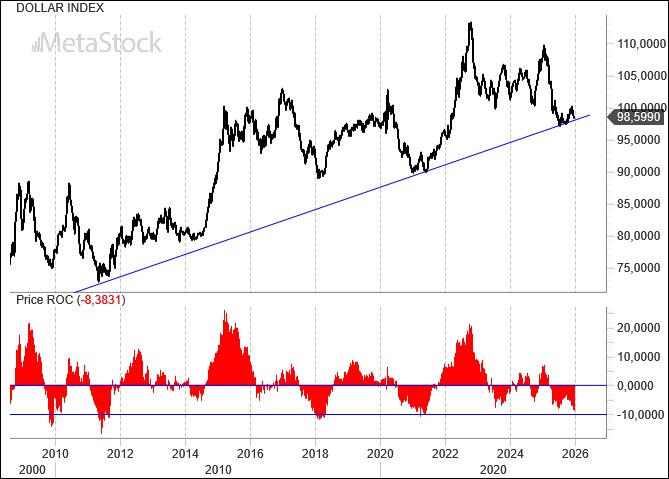
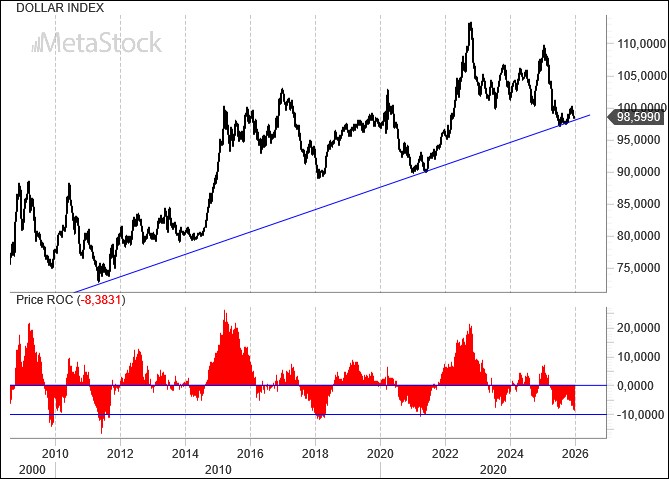
The Dollar Index continues to suffer from negative seasonality—December is historically the weakest month of the year—and the support level now being tested is one that, in the early months of 2026, could fuel a renewed upward reaction in the dollar.
This is not only a seasonal consideration. January and February are typically less unfavorable for the dollar, and technical indicators are also coming into play. The 52-week rate of change is approaching the key −10% threshold, a level that in the past has consistently triggered a rebound in the dollar. Should such a reaction fail to materialize, the outlook would point to a 2026 marked by even deeper dollar weakness than that seen in 2025.
Leave a Reply
You must be logged in to post a comment.