
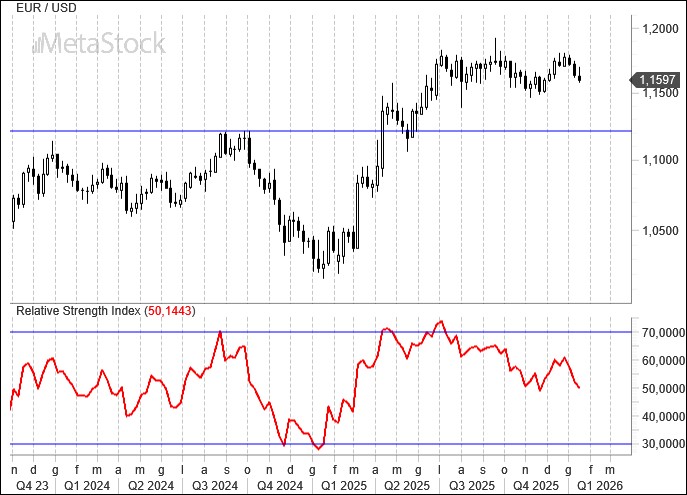
- Trump’s brand of neo-colonialism shows no sign of slowing. After Venezuela, Washington’s focus is shifting toward Iran and Greenland. At the same time, inflation continues to normalize, a trend that should allow the Federal Reserve to cut rates further – though the Powell affair looms large.
- Europe must also contend with mounting tensions with the U.S. over Greenland, complicating the already delicate management of the Ukraine issue, which has slipped somewhat into the background.
- EUR/USD edges lower again amid a broader flight to quality that is hitting the yen in particular, weakened by fiscal concerns that leave the Japanese currency increasingly fragile.
U.S. Inflation Continues to Cool
It was a busy macro week in the United States. The week opened with a major headline: an investigation into Federal Reserve Chair Jerome Powell over the costs of the central bank’s new headquarters – an issue repeatedly highlighted by Donald Trump as one of the more opaque aspects of Powell’s leadership. The risk of a gradual erosion of Fed independence would, in theory, argue against the dollar. Yet the greenback also had to digest December inflation data and, crucially, the Supreme Court’s ruling on tariffs.
U.S. inflation continues its slow glide toward the Fed’s 2% target. Core inflation in December rose at its slowest pace since March 2021, coming in at 2.6%. Markets are fully pricing in no change at the January 28 FOMC meeting, while speculation is intensifying around the future leadership of the Fed, with Powell’s term set to end in May.
The labor market also delivered positive surprises, with weekly jobless claims falling unexpectedly. Still, the broader backdrop is dominated by geopolitical developments that intertwine European, Chinese, and Middle Eastern interests.
After Venezuela, attention appears to be turning to Iran, where popular unrest is threatening the regime and being met with a harsh crackdown. Meanwhile, the Ukraine conflict has slipped down the agenda as Europe opens a new front over Greenland – an island under Danish control and part of NATO – amid Trump’s renewed interest. The deployment of a small pan-European military contingent risks further straining relations with Washington.
For now, this string of events has done little to dent equity market optimism, with stocks pushing to new all-time highs, while bond markets remain stuck in limbo. The dollar, by contrast, has regained some ground against the euro, with EUR/USD returning to the 1.16 area.
EUR/USD Remains in Stand-By Mode
Since the start of the year, EUR/USD has moved in essentially one direction: a modest but persistent decline. The renewed interest in the dollar reflects both sentiment – optimism around the greenback had become excessive – and seasonality, as January and February are historically favorable months for the U.S. currency.
This trend remains intact, with the 1.15 support line shaping up as the key level that will determine future tactical strategies on EUR/USD. A test of this area in the coming weeks cannot be ruled out.
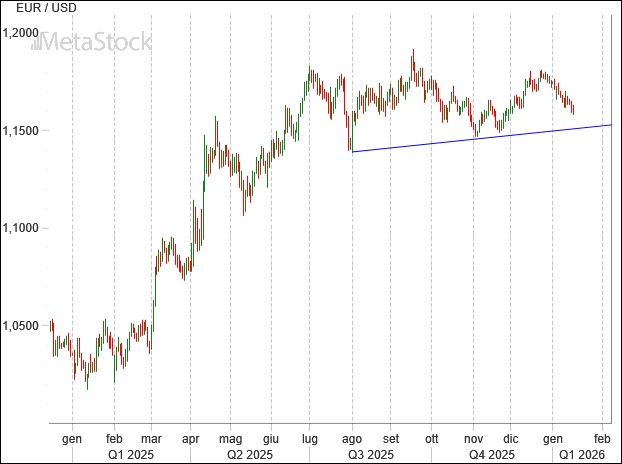
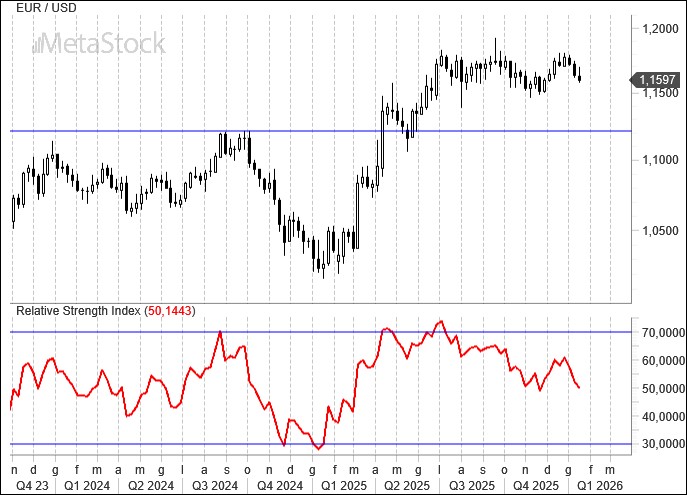
The summer overbought conditions in EUR/USD are giving way to an extended consolidation phase, helping to normalize sentiment among investors who had become heavily skewed toward long euro positions.
In an ideal scenario, the pair could drift toward the 1.124 support area, where euro buyers would likely re-emerge more decisively, aided by oscillator readings that would be far less stretched than in previous months. For the weeks ahead, two levels stand out as potential zones to begin rebuilding long euro positions: 1.15 and 1.124.
Leave a Reply
You must be logged in to post a comment.