
- While the Fed has delivered the long-telegraphed rate cut and signaled another reduction in the coming months, diplomatic tensions between the United States and Europe are intensifying. Donald Trump appears intent on using Ukraine as a lever to undermine the EU and its bureaucracy.
- In Europe, leaders are engaged in a tense round of meetings, trying to secure a voice in the Ukrainian question. The rift with Washington is widening, even as a war-driven economy is providing a lift to growth.
- As expected, EUR/USD is enjoying a strong December. The greenback is weakening under the Fed’s decision to lower rates again and the likely appointment of a Fed chair aligned with Trump.
Fed Caution, Political Pressure, and the Return of Geopolitics
Donald Trump wanted more, but Jerome Powell delivered only a 25-basis-point cut in the cost of money – a move markets had fully priced in for weeks. Caution remains the dominant tone within the FOMC. Until May, when the new Fed chair is expected to take office, policymakers are unlikely to go beyond a single additional cut, which would bring rates down to 3.5%. That level would hold pending a leadership change widely expected to be more Trump-aligned and therefore more inclined toward cheaper money.
The Fed’s restraint reflects a shortage of data caused by the government shutdown, as well as inflation that continues to hover stubbornly near 3%. The GDP deflator, most recently at 2.8%, underscores how difficult it has been to push inflation meaningfully lower. It remains unclear how much of this persistence is driven by tariffs versus an economy still running hot – particularly in real estate and financial markets, which have recently notched fresh record highs.
What most concerns the Fed is the persistence of long-term yields above 4%, a sign that markets are pricing in medium-term inflationary pressure. Adding to that is ongoing tightness in the labor market, exacerbated by reduced immigration flows that are pushing up labor costs and fueling wage pressures.
To address liquidity strains, the Federal Reserve will begin purchasing short-dated securities immediately, initially totaling $40 billion and tapering thereafter through April. This is less a traditional QE aimed at injecting liquidity than a technical operation to rebuild bank reserves and better manage recent stress in the overnight funding market.
Yet the dominant theme remains geopolitical. Trump’s rhetoric suggests rising tensions with Europe, now increasingly described as a former ally. A dangerous escalation around Ukraine is taking shape. Under a peace framework reportedly agreed between Russia and the U.S., Europe would be sidelined and Ukraine effectively forced into capitulation.
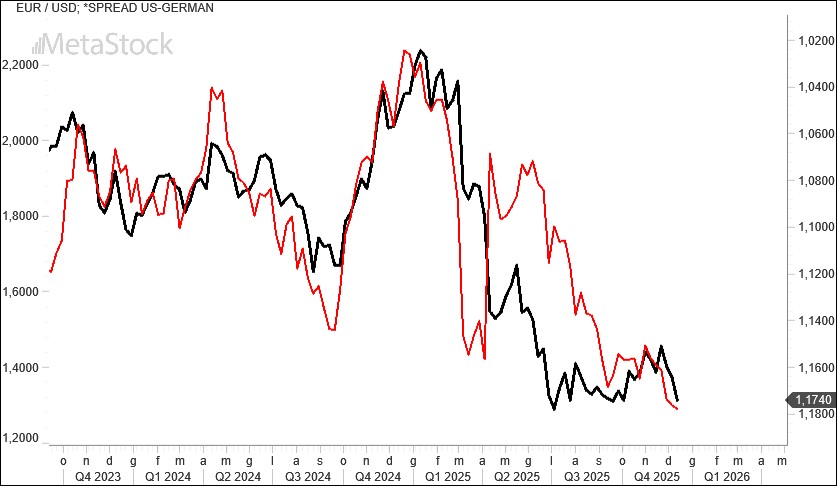
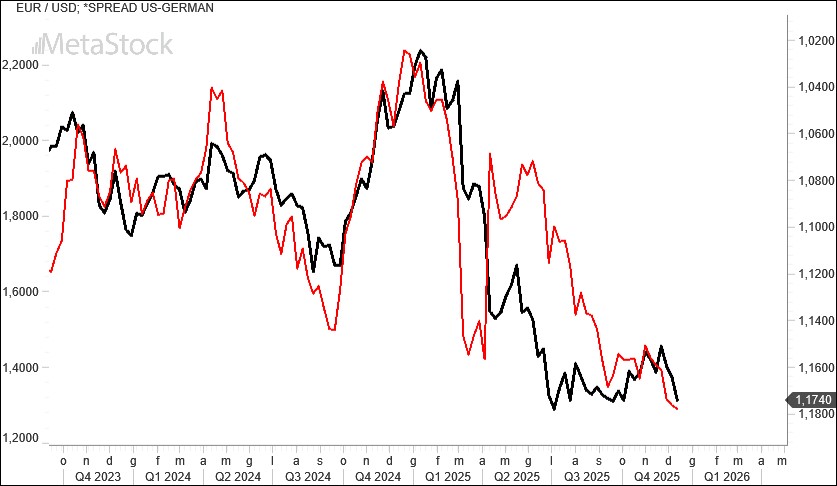
These tensions risk undermining the ongoing recovery, even as market signals tell a more constructive story. The yield spread between U.S. and German bonds has narrowed sharply and now sits at two-year lows below 140 basis points – an important development that, for now, supports the euro.
Technical Analysis: Seasonality and Chart Signals Point Higher for EUR/USD
December has historically been a favorable month for the euro, and this year is proving no exception. The single currency’s advance is being driven not only by U.S. rate cuts against a backdrop of stable – and potentially higher – European rates later in the decade, as some ECB officials have hinted for 2026, but also by the narrowing yield gap between U.S. and German 10-year bonds. That spread remains a key driver of EUR/USD.
As the chart shows, the spread is at its lowest level in two years. EUR/USD itself appears to be lagging the adjustment implied by these fundamentals and, based on these metrics, should be trading at higher levels than it is today.
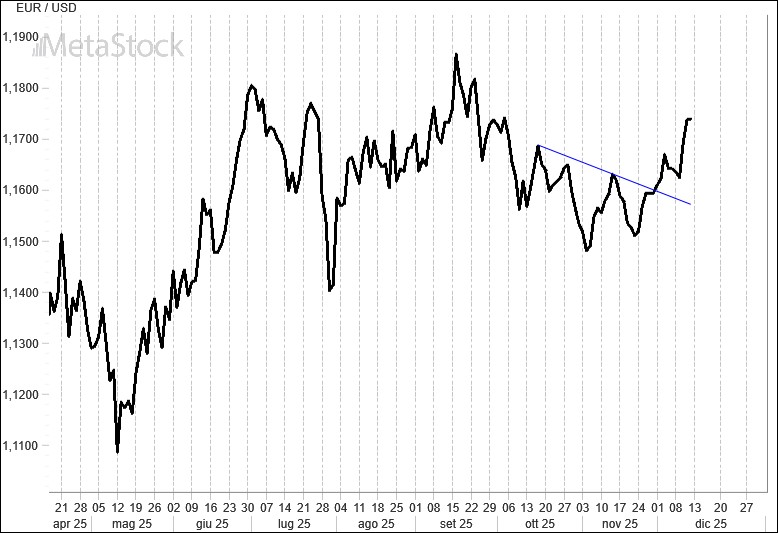
From a technical standpoint, the picture is equally compelling. EUR/USD has completed a bullish head-and-shoulders formation, a pattern that typically signals further upside. The move could carry the pair toward the area just below the 1.18–1.185 highs in the coming weeks. Seasonality favors the euro, momentum indicators are aligned for an extension of the rally, and chart dynamics now appear to confirm the move.
Leave a Reply
You must be logged in to post a comment.