
- The United States continues to deliver encouraging growth data, with the ISM manufacturing index back above the 50 mark. The Federal Reserve’s decision to keep interest rates unchanged looks increasingly justified.
- Europe shows little inclination to adjust its monetary stance, supported by stable inflation and early signs of economic recovery. Some moderate concern is emerging, however, over the euro’s current strength.
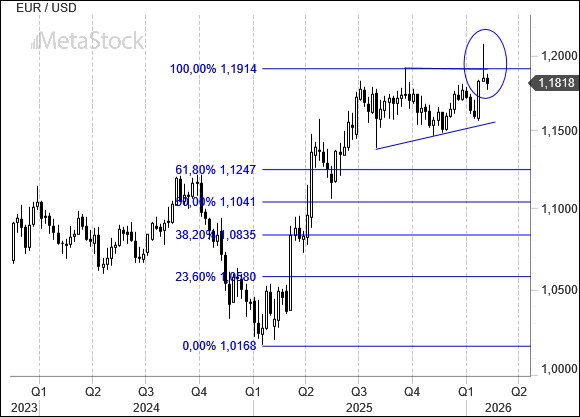
- EUR/USD has pulled back to 1.18 after last week’s sharp rally, later scaled down following the appointment of the new Fed Chair. Key resistance levels remain close at hand.
The U.S. Economy Is Moving – And So Is Europe’s
As widely expected, the European Central Bank left interest rates unchanged at 2%, indirectly confirming that a strong euro is not seen as a problem. If anything, it helps curb inflationary pressures at a time when domestic demand is driving growth across the euro area.
According to an ECB study, a 10% appreciation in the euro reduces inflation by around 25 basis points after 12 months. In the final quarter of 2025, consumption grew by 0.3%, beating expectations, while unemployment fell to 6.2%. Germany, Spain, and Italy all outperformed forecasts – figures that help put into context recent remarks by Merz regarding the euro’s underlying strength, which for now has not significantly hindered the recovery.
In the U.K., rates were also left unchanged, though markets increasingly expect the Bank of England to cut in the near term – a view that has weighed on sterling.
The U.S. economy, meanwhile, continues to defy monetary restraint, lending support to Powell and the Fed’s decision to hold rates steady. The ISM manufacturing index climbed to its highest level since August 2022, back above 50. The ratio of new orders to inventories reached its strongest reading since July 2021. Employment conditions improved, while the prices-paid subindex edged slightly higher.
Taken together, these figures justify the rise in U.S. 10-year Treasury yields above 4.25%, providing a safety net for the dollar and narrowing part of the divergence that had opened up with the U.S.-Germany yield spread since December.
EUR/USD and That Impenetrable Resistance
Followers of Japanese candlestick analysis will immediately recognize the shooting star pattern that formed at the end of last week, after EUR/USD attempted – and failed – to break above 1.19.
Between the arrival of a new Fed Chair and a run of solid macroeconomic data, the dollar managed to avert a bullish technical breakout that could have raised serious questions about its longer-term outlook.
It has long been clear that 1.19 – perhaps even more so than 1.20 – represents a critical resistance level. At that point, the upward leg that began in 2025 matches in magnitude the 2022–2023 move. Just above it also lies the 38.2% Fibonacci retracement of the entire EUR/USD decline that began in 2008.
That helps explain why the market is hesitating at these levels. The first attempt has failed; the question now is whether this is merely a postponement or a more meaningful signal of renewed demand for the dollar. For the moment, our preferred scenario still sees the U.S. currency as relatively unattractive within a hypothetical ex-euro currency portfolio.
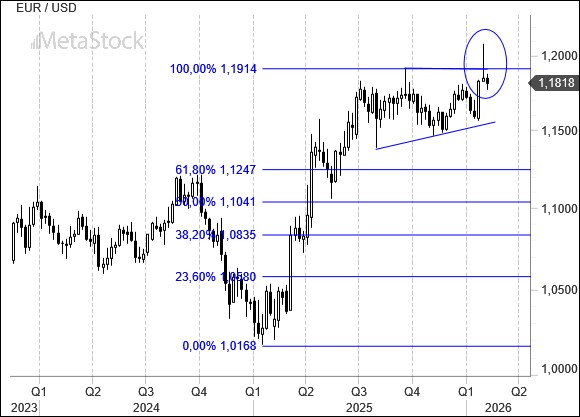
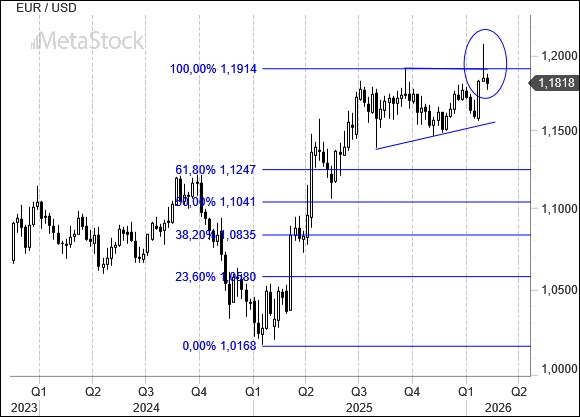
Whether the late-January move in EUR/USD turns out to be a bull trap will soon become clear – specifically if the pair returns to test the 1.15 support area and breaks below it. Such a move would confirm that the rally, which stalled near critical resistance, was an overstretched advance destined to reverse.
Only a sustained move below 1.15 would shift the outlook decisively in favor of the dollar.
Leave a Reply
You must be logged in to post a comment.