
- Tariffs, Federal Reserve independence, competition from cryptocurrencies, geopolitics, and political elections are among the forces likely to influence the U.S. dollar’s valuation in 2026. A recent J.P. Morgan report offers an insightful framework.
- Europe’s key challenge in 2026 will be to strengthen its independence from the United States, proving it can remain cohesive in the face of the economic and geopolitical pressures the new year is likely to bring.
- EUR/USD closed 2025 not far from critical resistance levels. Technical analysis will be pivotal in gauging price intentions in 2026.
America’s challenges in 2026
With macroeconomic data largely absent due to the Christmas and year-end holidays, and while waiting for fresh signals from the markets in the coming sessions, it is worth revisiting an interesting J.P. Morgan report published at the end of 2025.
The bank outlined its view on the future of the U.S. dollar. After a roughly 14-year bullish cycle that culminated in early 2025, with the real effective exchange rate at its highest levels since the 1980s, the dollar has, according to U.S. analysts, embarked on a new bearish trajectory that could extend over the coming years—barring disorderly shocks.
Dollar strength was supported by three pillars: U.S. economic growth outperforming the rest of the world; higher real yields and the exceptional performance of U.S. equities; and confidence in institutions, including the rule of law, the independence of the Federal Reserve, and the dollar’s role as a safe haven.
Those pillars are now shifting. U.S. tariffs and reduced trade openness are expected to gradually shrink the current-account deficit, lowering U.S. demand for foreign goods. This would force countries such as China and Germany to stimulate domestic demand and retain more capital at home, rather than reinvesting it in dollar-denominated assets. At the same time, reflation in Japan and rising local yields may encourage Japanese investors—among the largest foreign holders of U.S. Treasurys—to repatriate capital, further weakening the dollar.
There is also the Federal Reserve, with the risk that its next chair may not act independently of political pressure from Trump. Cryptocurrencies are likewise cited as a potential competing means of payment, representing another risk factor for a dollar that, according to J.P. Morgan, is set to weaken progressively.
Estimated to be around 7% overvalued against the euro, the dollar still justifies hedging part of dollar-denominated assets, despite hedging costs having eased while remaining historically high. Given that relative valuation preferences for non-U.S. equity markets have historically coincided with weakness in local currencies, and that safe-haven status does not currently appear to be a defining feature of the greenback, reduced exposure to the dollar emerges as the report’s core message. This conclusion appears broadly reasonable, though it will ultimately need confirmation from market price action.
EUR/USD: what kind of 2026 lies ahead?
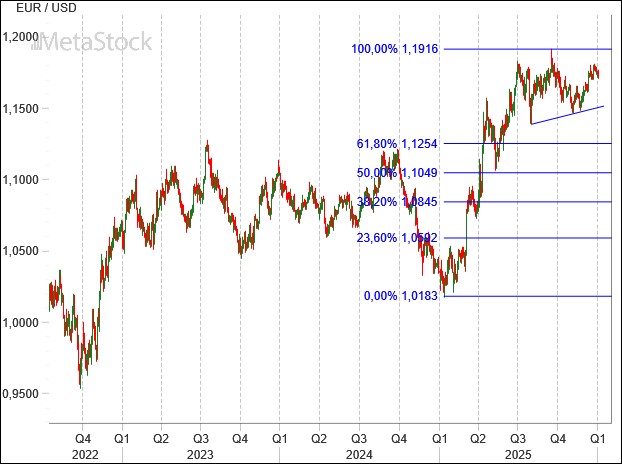
From a purely technical standpoint, EUR/USD did exactly what it needed to do in 2025. The upward leg developed during the year matched the 2022–2023 move in size, reaching the same target around 1.19.
A consolidation phase in front of such a significant resistance level was inevitable. What must not happen for the euro is a sustained move below the 1.12 area. Any downside swings in EUR/USD would, in theory, represent opportunities to hedge dollar currency risk, while a clear break above 1.19 would definitively end the consolidation phase, paving the way for a 2026 that could once again be unfavorable for the greenback.
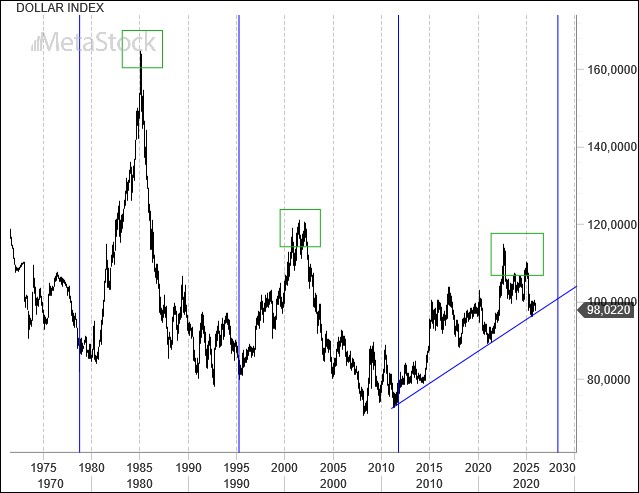
A formal trigger is still missing, but if a bearish break were to occur in the long-term uptrend line that has guided dollar strength since 2011, it would offer a strong time signal, pointing to what could become a major cyclical low for the U.S. currency.
Very long-term cycle analysis suggests that roughly every 200 months, the dollar has formed a significant bottom in its history, followed by a sharp rebound. On that basis, the spring of 2028 could be the period when investors begin positioning for renewed dollar strength—should the support zone around 96–97, currently in play, give way.
A leadership change at the Federal Reserve in the first half of 2026 could be the ideal market mover to trigger a more pronounced phase of dollar weakness.
Leave a Reply
You must be logged in to post a comment.