

- The U.S. President continues his campaign against the Federal Reserve, escalating pressure on Governor Cook with accusations that could force her resignation and pave the way for a White House–aligned appointee. Meanwhile, Jerome Powell has adopted a more dovish tone, and a rate cut in September looks increasingly likely.
- In Europe, markets are rattled by political and debt risks in France. The government’s request for a confidence vote has sent French bond spreads higher, with the possibility of early elections looming.
- EUR/USD tested resistance but pulled back following the French political crisis. The euro still needs time to consolidate before attempting another push toward the 1.20 mark.
Trump Pressures the Fed as France’s Crisis Lifts Dollar
After Powell’s dovish signals at Jackson Hole, the White House stepped up its confrontation with the Fed, demanding Governor Cook’s removal on allegations of fraud. Whether or not the accusations hold, Donald Trump’s not-so-subtle effort to steer monetary policy toward a looser stance is becoming increasingly clear.
Bringing the central bank under tighter political control has become an explicit goal—even at the cost of undermining its independence and credibility, and with it, risking volatility in the dollar’s valuation.
The dollar has already begun to reflect this new reality, but a critical break higher in EUR/USD was halted only by an external factor: the French political crisis.
France’s government has forced parliament to confront hard questions over public finances, sparking a surge in the spread between French and German 10-year bonds back to the 80-basis-point zone, a level last seen earlier this year.
With a confidence vote scheduled for September 8, the government faces long odds of survival. Early elections are a real possibility, placing President Emmanuel Macron in a precarious position.
The euro is bearing the cost of this political uncertainty, which may keep the ECB cautious for now. Across the Atlantic, few doubt that the Fed will proceed with a rate cut—unless August’s U.S. jobs report delivers a surprisingly strong reading.
Technical Analysis: EUR/USD Faces Resistance Before a Potential Breakout
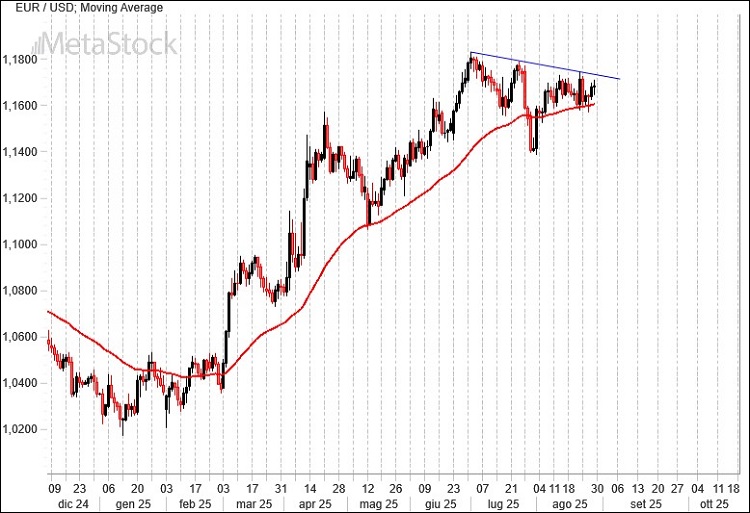
The euro’s attempt to break above the downtrend line that has capped the rally since late June was cut short by the French crisis, pushing the pair back toward its 50-day moving average, a key level that has supported prices since March.
Yet the limited follow-through on the dollar side, despite Europe’s political troubles, could be a sign of underlying weakness in the greenback. A sustained move above the 1.18 resistance area would open the way for a run beyond 1.20.
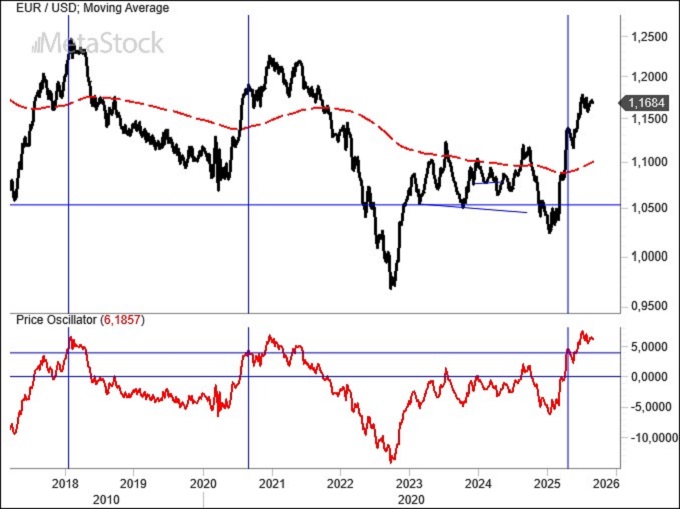
The euro still needs to work off the excess bullish momentum accumulated in recent months. One indicator pointing to this adjustment is the price oscillator, which measures the spread between spot prices and the 200-day moving average.
That spread remains at levels that historically favored dollar rebounds. If the greenback were to lose ground despite these technical conditions, it would send a strong signal that dollar short positions could be the trade of choice heading into the close of 2025.
Leave a Reply
You must be logged in to post a comment.