
- President Donald Trump is attempting to reassure voters, insisting that the war with Iran will be brought to a successful conclusion and that the economic cost, higher energy prices and more expensive raw materials, will ultimately be justified. Markets, however, remain unconvinced, continuing to sell off amid persistent uncertainty. Rising inflation pressures are already looming.
- Europe is among the regions most affected by the military escalation in the Gulf, with governments responding in a fragmented manner as they attempt to contain the risks of energy shortages. Meanwhile, the European Central Bank is preparing for potential rate hikes by the summer.
- After briefly attempting to reclaim the 1.16 level, EUR/USD has pulled back, with the U.S. dollar remaining well supported as investors seek safety. Key support levels now come into focus, below them, the dollar could accelerate its rally.
The Risk of a Global Recession
The prospect of a global recession is increasingly being discussed within the corridors of the White House, as Trump continues to promise a resolution to the conflict with Iran within weeks. Markets appear skeptical. Equities remain weak, bond yields are rising, and oil prices continue to push higher.
The inflationary impact, driven by rising oil, gas, and other commodity prices, appears unavoidable. Central banks may have little choice but to acknowledge the shifting environment and resume tightening monetary policy in order to curb resilient demand.
A resurgence of inflation, or worse, an outright economic downturn, is precisely what Trump hopes to avoid ahead of the autumn political cycle, where delivering tangible results to American voters will be critical.
Even the Federal Reserve, under its new leadership, is unlikely to come to the administration’s aid. Raising rates under current conditions risks exacerbating already fragile economic dynamics.
A similar dilemma is unfolding in Europe, where the European Central Bank is preparing to adjust borrowing costs higher as inflation risks edging back toward 3%. The concern is whether such tightening could further weigh on growth and potentially tip the region into recession.
In this complex backdrop, the U.S. dollar continues to serve as a safe haven. Recent price action suggests that investors may still be positioning for further upside in the greenback.
EUR/USD: The Dollar Makes Another Attempt
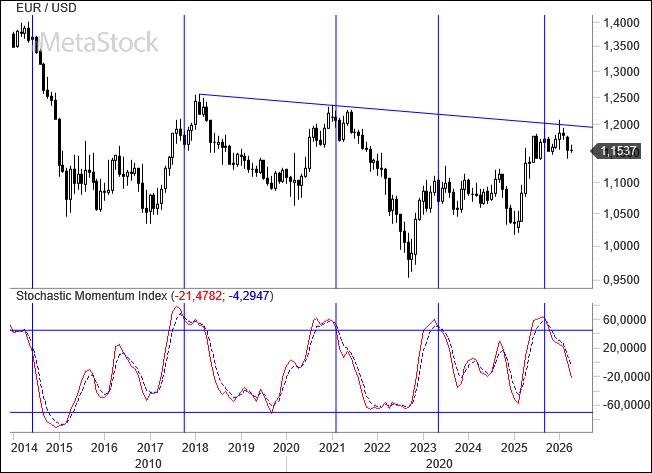
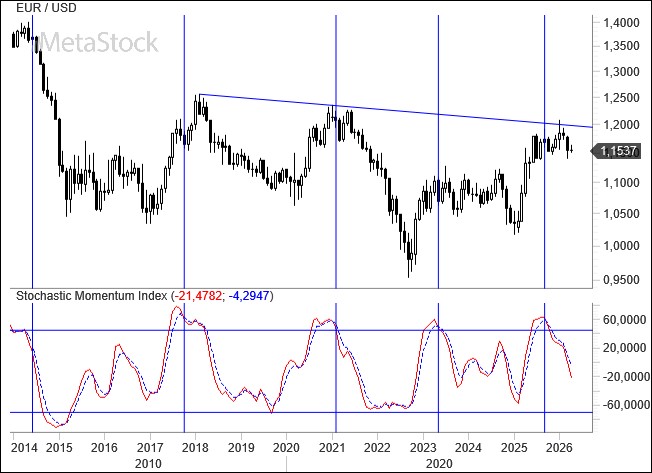
From a technical standpoint, the monthly EUR/USD chart, combining price action with momentum oscillators, does not yet suggest that the euro’s corrective phase has run its course.
The bearish signal triggered in September 2025 has so far resulted in only limited downside for the single currency, but it has yet to fully play out. As a result, betting against the dollar may still be premature.
The ongoing battle in EUR/USD is likely to shape market direction for the remainder of the year, with developments in the coming weeks, particularly on the geopolitical front, set to play a decisive role.
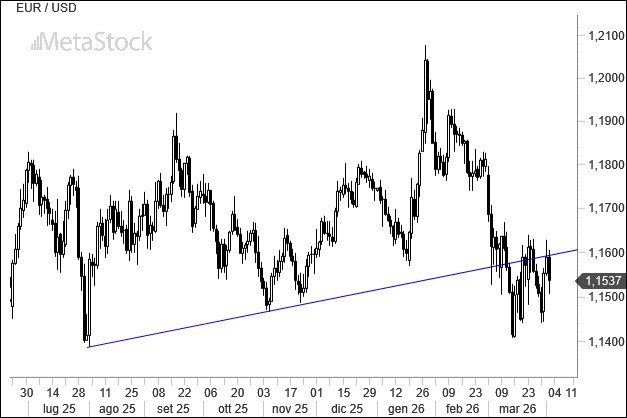
The failed downside break in early March, which found support near 1.14, initially brought euro buyers back into the market. However, that recovery proved short-lived, as sellers quickly regained control.
A sustained move above 1.16 would have been key to supporting a more constructive outlook for the euro. Instead, the pair has now failed twice to reclaim what was once support and is now resistance, a development that raises concerns.
Markets are unlikely to remain indecisive indefinitely. The longer EUR/USD trades below 1.16, the greater the probability of renewed dollar strength, with an initial move toward the 1.12 area increasingly likely.
Leave a Reply
You must be logged in to post a comment.