
- The U.S. has not managed to secure a quick victory over Iran, as Trump had hoped, and energy prices now risk pushing the global economy toward stagflation. The inflationary effects are unlikely to take long to appear, which is why the Fed is also watching upcoming data closely and is not ruling out a rate cut by year-end. Bonds and equities have both suffered sharp declines.
- Europe appears to be among the hardest-hit economic regions, given its dependence on fossil fuels. The ECB is taking its time on rates while it waits to better understand the future path of inflation, but in the meantime the Bund has reached 3%.
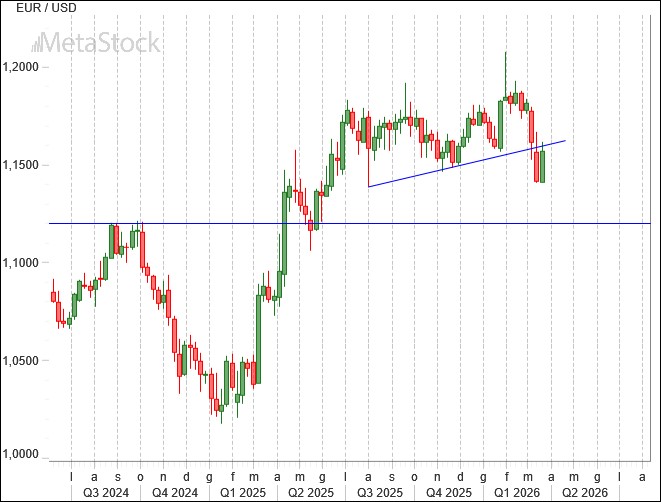
- EUR/USD attempted a rebound, only for it to be immediately neutralized by fresh records in oil prices. The dollar continues to serve as a safe-haven asset, attracting a market that is cautious and fearful at the moment, though it has not decisively broken higher against the euro.
Stagflation or recession? That is the question
There is little doubt about the negative impact that the surge in energy prices will have on global inflation, but also on economic growth, which is inevitably being hit by a geopolitical crisis. That crisis has so far produced broadly flat equity markets since the start of the year, while bond yields have climbed sharply as investors increasingly price in a higher-inflation scenario.
Inflation will likely settle around 3%, not 2%, as the new normal, something several central banks around the world are beginning to recognize. Australia and Norway, for example, are two commodity-producing countries that are starting to grapple with rising inflation, responding either with rate hikes, in Australia’s case, or by suspending cuts, in Norway’s.
The U.S. and Europe are facing similar problems. Powell, nearing the end of his term as Fed chair, has acknowledged that the outlook is too uncertain for any move on rates, with employment stalling and the risk of renewed inflation flare-ups still present.
In the background are the midterm elections, with Trump needing to deliver concrete results if he does not want to face voters amid rising unemployment and soaring gasoline prices.
Europe, too, is going through a far from positive moment, given its dependence on fossil fuels. Gas and oil prices are a concern, but above all so is the continuity of supply. Governments already burdened by debt will not be able to pursue expansionary fiscal policy, just as the ECB will struggle to ease rates. What is needed is greater visibility on the inflationary impact of recent events. Lowering the cost of money now would risk adding fuel to the fire, especially with a euro that has already weakened, though for now it is still broadly holding its ground.
EUR/USD: The euro tries to hold the line
The bearish break below 1.16 was confirmed by the weekly close, but it did not trigger a major follow-through. The August low now stands as the final hurdle before a deeper dollar move toward the substantial support area at 1.12, where the highs of 2023 and 2024 converge. Just above that, the 38.2% retracement of the entire previous rally should help support the single currency.
The Fed did not sound especially dovish at its latest meeting, even while keeping in place its forecast for rate cuts by year-end. At the moment, the market is worried about stagflation, and holding the safe-haven dollar in a portfolio feels useful. But as seen at the end of the week, investor conviction is not all that strong.

The Dollar Index is about to close the third quarter of the year right up against a crucial resistance level. After strengthening sharply, particularly against the euro and the Japanese yen, the Dollar Index is now testing the 100 level, a threshold that has repeatedly capped the greenback in the past.
Given that three separate lows were formed around the 96 area, a break above 100 would point to a further 3% to 4% gain for the dollar over the coming months, likely in an environment marked by heightened geopolitical tension and recession risk.

Leave a Reply
You must be logged in to post a comment.