
- Geopolitics, tariffs, and monetary policy dominated the past week, with a public clash between Donald Trump and Jerome Powell over interest rates and the naming of Powell’s successor at the Federal Reserve, Kevin Warsh. The developments unsettled markets and weakened the dollar after Trump openly welcomed its softness.
- Europe risks slipping back into a deflationary scenario—an outcome the ECB is keen to avoid as it seeks to preserve a degree of rate neutrality. Germany’s prime minister, Merz, has also drawn attention to the exchange rate.
- EUR/USD pushed through its 2025 highs before retreating following Warsh’s appointment. It was a pivotal moment that could mark the start of a fresh wave of dollar weakness.
Powell Challenges Trump as Warsh Is Chosen
Speculation about coordinated U.S.–Japan intervention to support the yen was enough to push the dollar lower and pull the Japanese currency away from the critical 160 level.
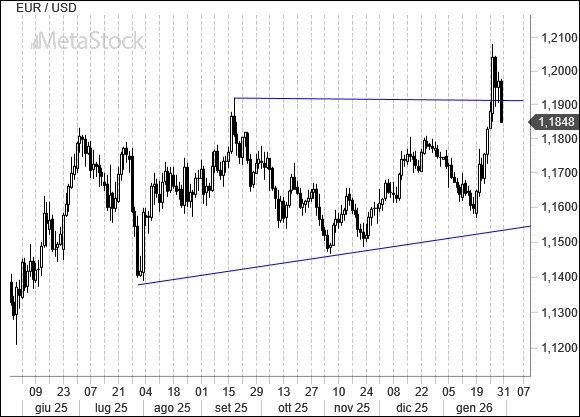
The sharp move that saw EUR/USD vault the key 1.19 technical threshold carried significant implications, particularly because it came during a period that is typically seasonally supportive for the greenback. That said, the move quickly reversed after the appointment of Kevin Warsh to lead the Federal Reserve.
While the dollar against G10 currencies is approaching its 2025 lows, the decline versus emerging-market currencies is already well advanced. Geopolitical tensions—most notably involving Iran—alongside renewed tariff disputes with South Korea and Canada continue to keep markets on edge.
Trump, irritated by comments made by Mark Carney in Davos, has threatened additional tariffs on Canadian goods. At the same time, he has imposed duties on South Korea, arguing that Seoul failed to deliver on regulatory commitments tied to the 2025 trade deal.
Trump has also settled on who will succeed the increasingly unwelcome Jerome Powell at the Fed. His choice, Warsh, is no policy dove and is therefore unlikely to preside over a rapid easing cycle. That outcome weighed on precious metals—erasing much of their prior gains—while providing late-week support to the dollar.
“The economy remains solid,” Powell said following an FOMC meeting that produced no policy changes. Unemployment is stable, and consumer spending remains resilient despite tariffs. In short, there are few immediate reasons to cut rates, leaving the issue firmly in Warsh’s hands going forward.
The dollar recovered some ground after an earlier slide triggered by Trump’s remarks welcoming a weaker currency as a boost to U.S. export competitiveness.
EUR/USD Technical Analysis: The Moment of Truth
We have long argued that clearing the 1.19 highs set in 2025 would be a critical test for the pair’s longer-term trajectory. The move sparked by Trump’s comments was undeniably significant, especially given the seasonally favorable backdrop for the dollar.
Once enthusiasm for the euro cooled, speculative positioning quickly shifted.
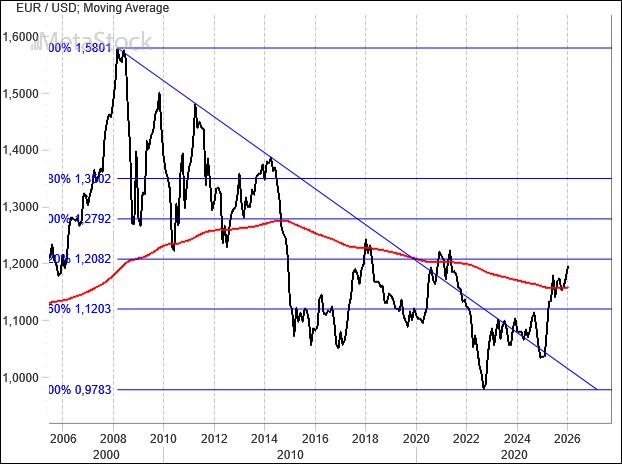
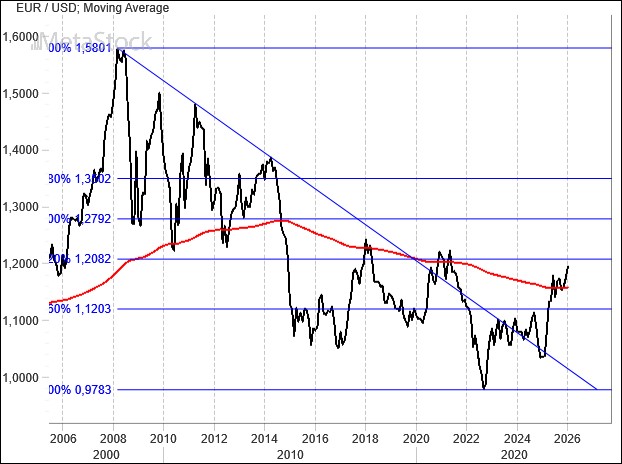
EUR/USD now faces a formidable hurdle: the 38.2% retracement of the entire decline that began after the 2008 financial crisis. A move beyond 1.208—and subsequently 1.23 and 1.25, the respective highs of 2018 and 2020—would have far-reaching implications for the dollar. In such a scenario, Europe could be forced to respond by cutting rates to counter renewed deflationary pressures.
For now, the 1.20 area could represent the right shoulder of a broader reversal pattern unfavorable to the dollar—one that could play out over several years, making U.S.-dollar-denominated assets less attractive. At this stage, however, Warsh’s appointment has been sufficient to cool the euro’s rally.
To avoid a classic bull trap, EUR/USD needed to fall back swiftly below 1.19—and it did, aided by the sharp drop in precious metals prices following the announcement of Warsh’s appointment, which breathed new life into the dollar.
The question now is whether this bull trap evolves into a broader counter-move in favor of the greenback. For EUR/USD, 1.15 remains the key level to watch. A break below would open the door to further dollar strength. A return above 1.19, by contrast, would confirm the start of a multi-month bullish phase for the euro.
Leave a Reply
You must be logged in to post a comment.