
- The U.S. economy is losing steam, and the Federal Reserve is widely expected to respond with a rate cut in December. Kevin Hassett now appears to be the frontrunner to replace Powell as Fed Chair.
- In Europe, the data flow was light, with Germany’s IFO survey once again underscoring the country’s sluggish economic recovery. The ECB is still poised to leave rates unchanged.
- EUR/USD has been holding firm at the 1.14–1.15 support zone and now looks positioned to climb as it enters one of the most seasonally favorable months of the year.
A Year-End Rate Cut From the Fed
The Federal Reserve is expected to lower rates on December 10, reflecting a market that now sees reduced inflationary pressure and a continued slowdown in the labor market. Powell is set to step aside in May, and early chatter out of Washington increasingly points to Kevin Hassett as the White House’s preferred successor.
Should the Fed bring the policy rate down to the 3.50%–3.75% range, it would likely be driven by softening price pressures in the services sector. Labor data, meanwhile, remain lukewarm, with early indicators hinting at a weaker-than-ideal October jobs report.
Thanksgiving ultimately proved less uncertain than initially feared—especially after last week’s heavy selling in tech stocks. A December rate cut from the Fed would likely deliver a boost to consumer spending, and U.S. equities are already behaving as if a push toward new highs is underway following a modest 5% pullback.
Speculation around a potential Hassett appointment has helped fuel expectations of looser regulation and a more dovish policy stance, pushing long-dated Treasury yields back down toward 4%.
Across the Atlantic, the only notable release was Germany’s IFO index, which came in slightly below expectations and reaffirmed the challenges facing Europe’s largest economy. None of this is expected to shift the ECB’s position, and rates should remain anchored at 2%.
The U.K. unveiled its new budget, featuring significant tax hikes and spending cuts aimed at stabilizing public debt. The British pound regained ground as markets took comfort in avoiding the kind of fiscal meltdown that cost Liz Truss her premiership.
For EUR/USD, this backdrop ushers in one of the pair’s historically strongest months.
A Difficult Month Ahead for the Dollar
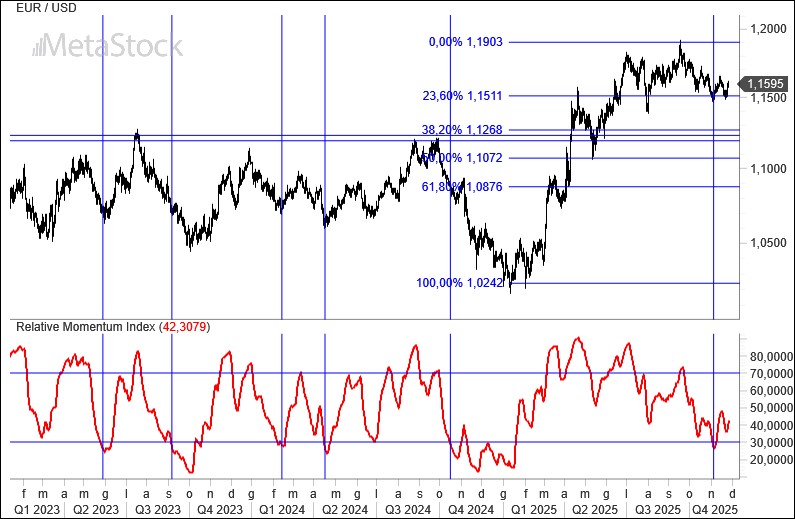
Over the past two years, momentum oscillators such as the RMI have consistently identified turning points for EUR/USD with solid precision. The only major exception was the final quarter of 2024, when the U.S. election cycle distorted the typical pattern. Aside from that anomaly, an oversold RMI—such as the reading seen in November—has generally preceded a euro rebound.
The key question now is whether history will repeat itself. A final dip toward 1.126 remains a plausible scenario—an attractive zone for investors seeking to hedge dollar-denominated assets or position against the greenback.
This region aligns with the 38.2% retracement of the euro’s 2025 bull trend and coincides with several prior swing highs. A move into that area would likely create a compelling divergence between price action and momentum indicators.
The December 10 Fed meeting may give markets the excuse they need to test that support. Alternatively, if the forming double bottom solidifies above 1.165, a return to last summer’s highs becomes the base-case scenario.
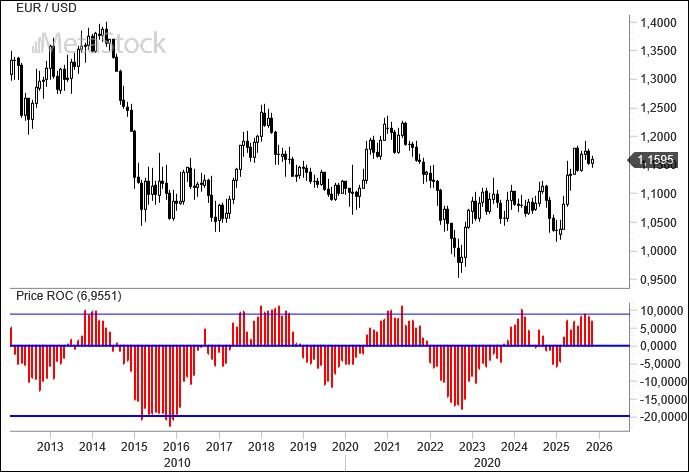
One factor that could temper the euro’s upside is the signal from the 18-month Rate of Change (ROC) indicator. As shown on the chart, any move above 9% over an 18-month period has historically curtailed EUR/USD’s immediate momentum, suggesting a need to unwind excesses.
This setup hints at a possible advance toward the top of the current trading range around 1.19—yet without the conviction needed to break meaningfully higher.

The long-term structure still allows for euro appreciation, though the broader signals argue against an extended breakout. Seasonal tailwinds may support EUR/USD through December, but structural constraints suggest gains could remain contained.
Leave a Reply
You must be logged in to post a comment.